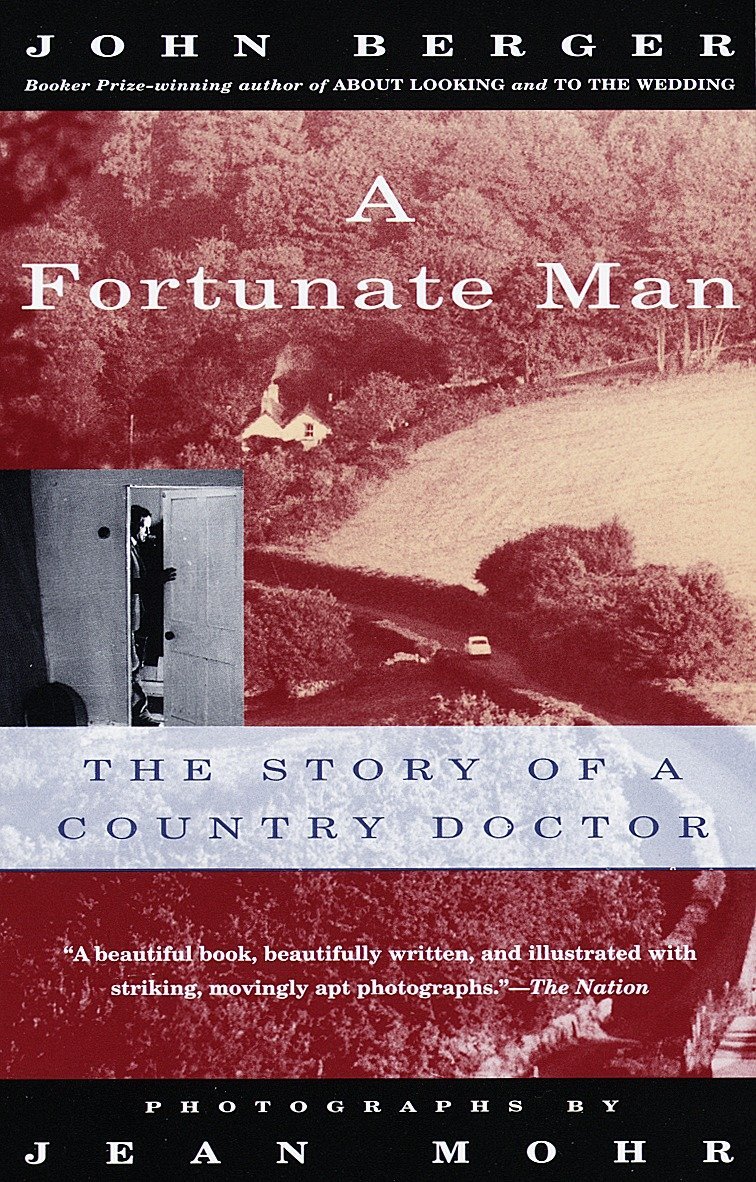
A Fortunate Man is a striking book, made more so by the fact that the country doctor John Eskell (“Sassall” in the text) killed himself fifteen years late after its publication. His depression is dealt with frankly in the book, although the conditions is not medicalized; it seems more the depression of a hero who can’t fully realize an impossible, noble goal. Perhaps, though, it was an illness, and part of Eskell’s drive was an effort to cure, or alleviate, his own illness. To Berger, it doesn’t matter. In a 2003 afterword, two decades after the doctor’s death, he writes:
“John the man I loved killed himself. And, yes, his death has changed the story of his life. It has made it more mysterious. Not darker. I see as much light there as ever. Simply more violently mysterious. This mystery makes me feel more modest, as I stand before him. And standing before him, I do not search for what I might have foreseen and didn’t—as if the essential was missing from what passed between us; rather I now begin with his violent death, and, from it, look back with increased tenderness on what he set out to do and what he offered to others, for as long as he could endure”.
But maybe this is a lesson about heroes, and moments—we search for a static image, a static virtue. But however we describe history—progress, tragedy—it’s made of fragments of motivations, of heroic impulses and not heroic people, of well-intentioned wickedness and unintentional mercy. Eskell thinks, he reflects. He is a man who has made a choice; he is not a prisoner of circumstances. He is wise enough to know that he is making a difference in the lives of these people, even if he also knows that they won’t remember them (and they didn’t; perhaps because of his suicide, he is not buried in the church graveyard, and little record of his presence survives in the village). And despite all of this, it sounds (and I am assuming here) like, at least in moments, all of that contextualization and knowledge wasn’t enough. He was in pain, somewhere and somewhen.
Ah, such little control! Even the philosophies and texts, all the science, can’t save us from the bleak moments. But perhaps contextualization is the problem, the search for meaning, the forgetting of the little events that pass. Each thing stands alone and brilliant; even the firing neuronal web that is meaning stands alone, unadorned, beautiful. The doctor concludes, in the last lines of the book: “Whenever I am reminded of death – and I think of it every day – I think of my own, and this makes me try to work harder.” To make this urge not tragic, to make it joyful through remembering those lonely, beautiful things, one by one, is maybe the highest thing we can hope for. 10
Berger, John and Mohr, Jean. A Fortunate Man: The Story of a Country Doctor. Penguin, 1967. Reviewed November 27, 2014. Edited September 9, 2025.